When the week has no margin left.
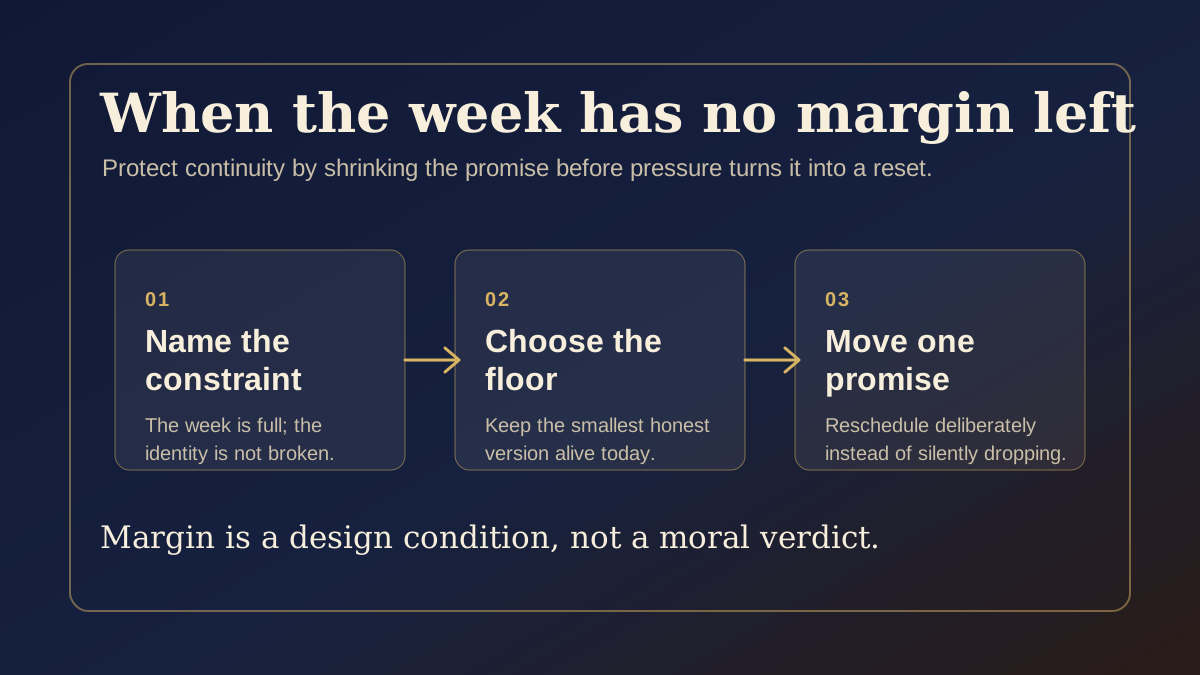
Answer first: do not interpret a full week as a failed identity. Name the constraint, choose the floor, and move one promise deliberately.
Quick answer
What should you do when the week has no margin left?
Name the real constraint, choose the smallest honest floor for the habit, and move one promise deliberately instead of silently dropping the whole routine.
The important distinction is simple: a capacity problem is not the same as an identity problem. A crowded week can still carry continuity if the promise is resized before it breaks.
Margin protection
A full week needs a smaller operating contract.
Most resets start when a good plan assumes a normal week after the week has already stopped being normal. The floor keeps the route visible without pretending the load disappeared.
- Name the constraint
- Say what is actually consuming the margin: travel, deadlines, care work, illness, recovery, or decision load.
- Choose the floor
- Define the smallest version that still keeps the cue and identity connected.
- Move one promise
- Reschedule the least urgent commitment deliberately so the system sees adjustment rather than abandonment.
The no-margin-week check.
- Do not moralize the calendar. A crowded week tells you about capacity before it tells you about character.
- Choose the smallest honest rep. The floor should be real enough to count and small enough to survive.
- Move one promise in writing. Silent dropping teaches the system that pressure means disappearance. Rescheduling teaches it that pressure means adjustment.
Why crowded weeks create false failure signals.
A full week often feels like proof that the whole routine was fragile. But the signal is usually narrower: the plan was built for a week with margin, and this week does not have any. That mismatch matters.
In Compounding Momentum, the useful layer is the one that keeps the system returning under ordinary pressure. When margin disappears, the next useful move is not a bigger promise. It is a smaller contract that protects the route until capacity returns.
The habit does not need to look impressive during a no-margin week. It needs to remain recognizable. One cue, one floor, and one deliberate moved promise can stop a temporary capacity squeeze from becoming a full identity reset.
Practical examples
Floors that keep continuity alive.
- Writing: open the document, add one sentence, and move the deeper draft block to a named day.
- Training: do mobility and one set, then reschedule the full session instead of treating it as missed.
- Reading: read one page at the usual cue, then mark the next normal reading window.
- Planning: capture tomorrow's first action instead of completing the whole weekly review.
- Recovery: protect sleep or shutdown as the habit floor because recovery is the constraint, not a detour.
Connect the no-margin week to the right note.
If the routine itself feels too rigid, read when consistency starts to feel brittle. If the work feels unrewarding, read when a habit needs less feedback. If the whole week has already gone sideways, read self-discipline after a disrupted week.
Use this script
The no-margin-week rule.
Use this before a crowded week silently converts every useful promise into optional background noise.
- The real constraint is...
- Name the pressure plainly so you solve capacity instead of attacking character.
- The floor that still counts is...
- Pick the smallest rep that keeps the cue, identity, and route connected.
- The promise I am moving is...
- Choose one overloaded commitment and give it a new explicit time.
When the workbook helps.
A one-off no-margin week can be handled with the floor rule above. A repeated pattern needs a better planning surface. The Companion Workbook helps when every busy week turns into a reset because the plan has no recovery lanes, no floor definitions, and no review rhythm.
If you are still naming the layer, start with Chapter 1 and the Seven-Layer Audit before adding more structure.
Take the smallest useful next step.
If the week has no margin, choose one route that protects continuity before you redesign the whole routine.