How to recover after breaking a habit without starting over.
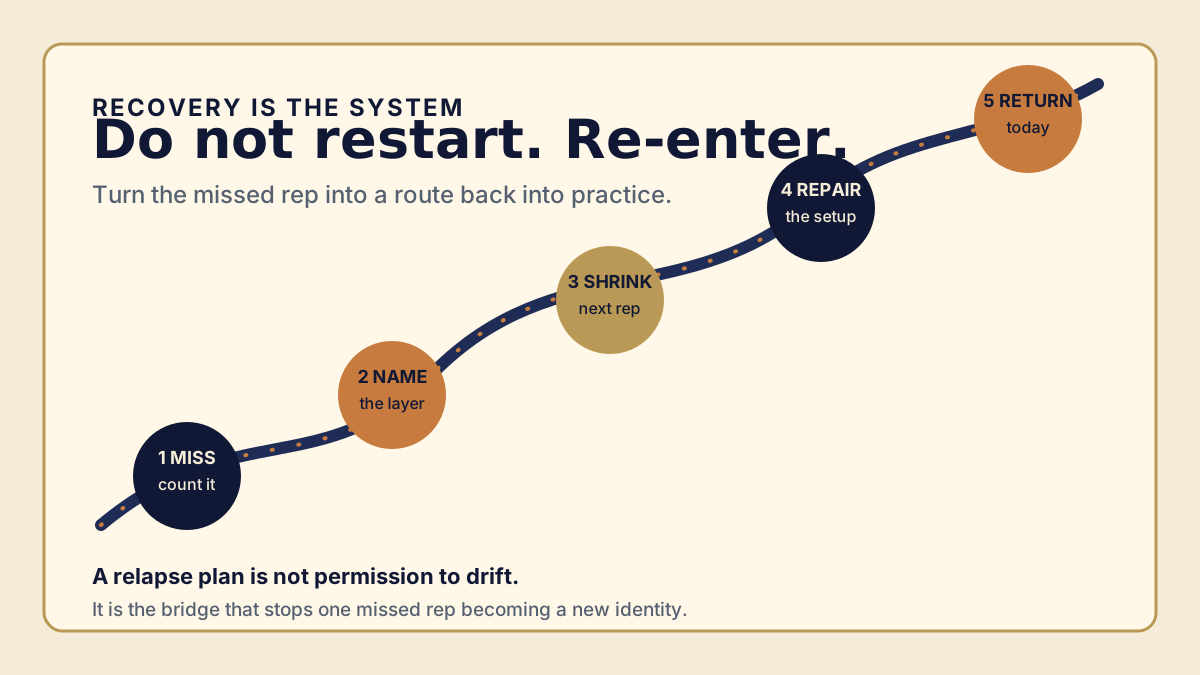
Answer first: recover from a broken habit by re-entering the practice quickly. Count the miss, name the layer that broke, shrink the next rep, repair one part of the setup, and return today.
Quick answer
How do you recover after breaking a habit?
Recover by treating the missed rep as information, not a verdict. Write down what happened, identify the layer underneath the break, choose a smaller next rep, adjust one piece of the setup, and do the recovery version today.
The mistake is trying to rebuild the whole identity after every miss. You do not need a new self. You need a reliable return path.
Relapse recovery
A habit relapse plan is part of the habit.
If a practice has no recovery version, one difficult day can become a full reset. Build the return route while you are calm, then use it when the ideal version fails.
- Count the miss
- Record it plainly without turning it into a character judgment.
- Name the layer
- Was the break caused by identity, emotion, environment, energy, time, social field, or feedback?
- Return today
- Do the smallest honest version before the reset story grows.
The five-step recovery loop.
- Count the miss without drama. “I missed Tuesday” is useful. “I always ruin this” is noise. The first sentence keeps the system inspectable; the second sentence makes the failure bigger than the behavior.
- Name the layer that broke. A missed workout may be an energy problem. A missed writing session may be an environment problem. A missed review may be a feedback problem. The label matters because different layers need different repairs.
- Shrink the next rep. Do not bargain with the ideal version. Choose the smallest version that still belongs to the habit: one page, one paragraph, ten minutes, one prepared meal, one walk, one cleared surface.
- Repair one part of the setup. Move the cue, lower the friction, pick the time, charge the tool, write the next first step, or remove the obvious obstacle. One setup repair beats a theatrical restart.
- Return today. The goal is not to erase the miss. The goal is to stop the miss from becoming the new default.
Why starting over feels good and works badly.
Starting over feels clean. It gives you a fresh date, a fresh notebook, a fresh streak, and a little emotional relief. But it also teaches the system that a missed rep requires a ceremony before you are allowed back in.
That is expensive. The longer the ceremony, the harder the return. The habit becomes less about the useful behavior and more about waiting for the next perfect starting line.
A recovery loop removes the ceremony. You miss, inspect, adjust, and re-enter.
Practical examples
What does a recovery version look like?
- Reading: one page with the book already open, not a demand to catch up on the whole week.
- Exercise: a ten-minute walk or mobility set, not punishment for missing the ideal session.
- Writing: one paragraph or one outline bullet, plus the next sentence left visible for tomorrow.
- Planning: choose tomorrow's first task, not a complete calendar rebuild.
- Household routine: clear one surface that lowers tomorrow's friction.
Use the seven layers instead of blame.
In Compounding Momentum, a repeated break is not treated as a simple willpower failure. It is a signal from one of the layers underneath the tactic: identity, emotion, environment, energy, time, social field, and feedback.
If the habit breaks every time the day runs late, the time layer needs a recovery version. If it breaks when the room is set up for the old loop, read the note on environment design for self-discipline. If it breaks after too many small choices, read decision fatigue is not a self-discipline problem. If the miss keeps becoming shame, use the tiny review loop before changing the plan.
The useful question is not “Why am I so inconsistent?” The useful question is “Which layer made the return path too expensive?”
Use this script
The two-minute habit recovery script.
Write this down immediately after a miss. Keep it factual enough that your next action is obvious.
- I missed because...
- Name the concrete condition, not a personality flaw.
- The weak layer was...
- Pick one layer so the repair stays narrow.
- Today I will re-enter by...
- Choose the smallest honest version and do it before redesigning.
When the recovery loop needs the workbook.
A one-off miss can be handled with the loop above. A repeated miss needs a practice surface. That is where the Companion Workbook becomes useful: it turns the diagnosis into prompts, weekly reviews, and visible adjustments instead of another burst of intention.
Use the workbook when you can say, “This is the layer that keeps breaking, and I need a structured way to practice the repair.” If you cannot name the layer yet, start with the free chapter and audit first.
Take the smallest useful next step.
If the habit broke today, do the recovery version before buying anything. If the same pattern keeps repeating, use Chapter 1 and the Seven-Layer Audit to name the weak layer.