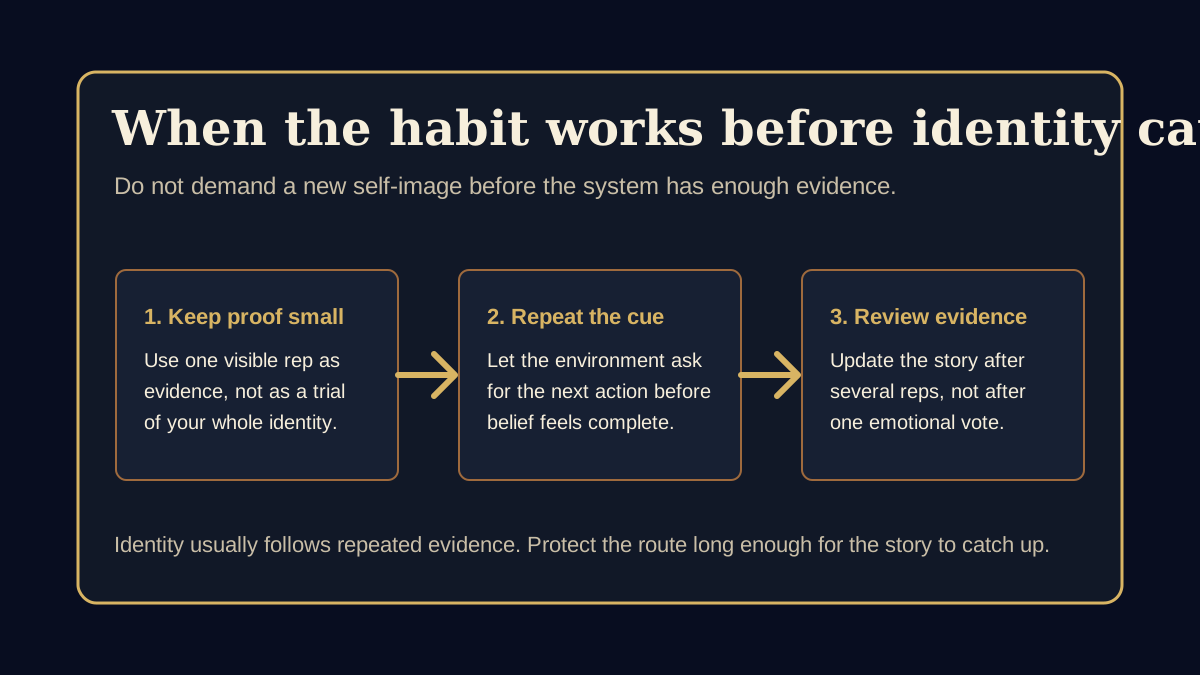
When the habit works before identity catches up.
Answer first: do not make the habit prove a whole new identity today. Keep the proof small, repeat the cue, and let the story update after the evidence is boringly real.
Quick answer
What should you do when a habit works before identity catches up?
Keep the proof small, repeat the cue, and review the evidence later. The identity story does not need to feel complete before the useful action is allowed to continue.
This is the strange part of durable change: the useful action can become repeatable before it feels like you. If you treat that awkwardness as hypocrisy, you interrupt the exact evidence that would have made the new story believable.
Identity map
Let evidence lead the story.
The danger is asking identity to certify the habit too early. Before judging the system, look for one proof, one cue, and one review point.
- Keep proof small
- Count the actual rep instead of asking the rep to prove a permanent character change.
- Repeat the cue
- Let the same place, time, or object invite the action before belief feels natural.
- Review evidence
- Update the identity story after several repetitions, not after one emotional vote.
The identity-lag check.
- Ask whether the action is working even if the story feels old. A useful rep still counts when it feels unfamiliar.
- Keep the cue doing the work. The environment should carry the next move while identity is still catching up.
- Review the pattern, not the mood. A week of evidence is a better identity input than one flat session.
Why good habits can feel fake.
A new routine often starts as a borrowed shape. You are doing the action, but the old self-image still has the louder voice. That mismatch can feel dishonest, especially when the habit is tied to a word like disciplined, writer, runner, calm, or reliable.
In Compounding Momentum, identity is one layer in the system. It matters, but it should not be forced to carry the entire habit before the cue, environment, and review loop have produced enough evidence.
The useful order is smaller: do the rep, keep the cue visible, record the proof, and let the identity claim become a summary of repeated evidence instead of a demand made in advance.
Practical examples
When the action is ahead of the story.
- Writing: you opened the draft three mornings in a row but still do not feel like a writer.
- Training: you finished the short workout but still think of yourself as inconsistent.
- Reading: you kept the page streak alive but still feel like someone who never reads.
- Planning: you wrote tomorrow's first action but still expect the day to drift.
- Recovery: you used the evening cue but still feel like the old pattern owns the night.
Connect identity lag to the right note.
If the useful habit has become invisible, read when a useful habit becomes invisible. If progress feels too slow to trust, read when progress feels too slow to trust. If consistency starts to feel brittle, read when consistency starts to feel brittle.
Use this script
The evidence-before-identity rule.
Use this when the habit is working but the self-image still feels unconvinced.
- The proof is...
- Write the smallest true evidence that the action happened.
- The next cue is...
- Name the place, time, or object that will ask for the next rep.
- The review date is...
- Choose when you will look at the pattern before making identity claims or quitting.
When the workbook helps.
An awkward identity week can be handled with the evidence-before-identity rule. A repeated pattern of quitting because the new action does not feel like you yet needs a stronger review surface. The Companion Workbook helps when the habit needs visible evidence, a stable cue, and a review cadence that lets the self-image update without drama.
If you are still not sure which layer is breaking, start with Chapter 1 and the Seven-Layer Audit before adding another identity goal.
Take the smallest useful next step.
If the habit works before identity catches up, choose one route that protects evidence before the old story turns the action into a verdict.